
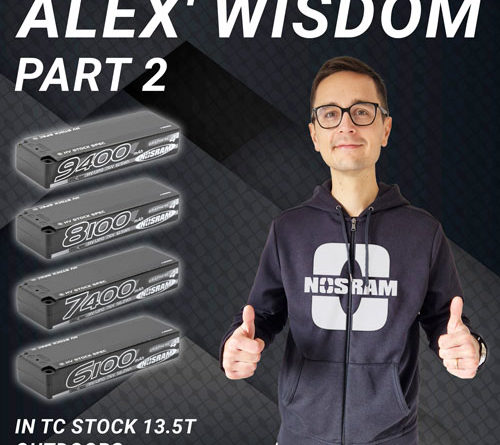
Alex‘ Wisdom • Part 2 • Battery choice for TC Outdoor Spec Racing.
Alex' Wisdom • Part 2 • Battery choice for TC Outdoor Spec Racing.

Right in time for the start of the outdoor season Team Nosram’s Alexander Hagberg did a comprehensive TC Stock 13.5T asphalt outdoor test with his XRAY X4 in Lisbon/Portugal and shares his findings with you below and in his YT video
„Making the correct battery choice can be difficult, but I will give you some suggestions which can help you to choose better.
First, which batteries do NOSRAM offer for TC outdoor spec racing? Here they are:
• All the batteries are the same length, the industry standard of 139mm.
• The difference comes with the height and weight of the batteries.
• The 6100 pack (#999655) has a height of 22.5mm, and a weight of 273g.
• The 7400 pack (#999652) has a height of 25.1mm, and a weight of 302g.
• The 8100 pack (#999656) has a height of 25.1mm, which is the same as the 7400, but with a weight of 327g.
• The 9400 pack (#999654) has a height of 25.1mm, which is the same as the 7400 and 8100, but with a weight of 335g.
I would say that the rule of thumb here is that the thinner the battery, the higher the IR numbers will become. IR refers to internal resistance, and you want this number to be as low as possible. A lower IR number is
important to achieve the best possible punch, and least possible drop off during a run.
The benefit of a lighter and thinner pack, however, is of course, a lower CG (center of gravity) in the car, which
will make the car more reactive, more responsive, and will overheat the tires less than a bigger battery.
So – this is the tricky part. How do you make the trade-off between the best possible handling from
the chassis vs. the best possible punch and least drop off from the battery?
I would say that for lower grip tracks, the benefits of a lighter pack, in terms of handling, will often outweigh the increased punch benefit from a bigger pack. I experienced this at my home track last weekend where I went quite significantly faster over a 5-minute run with the 7400 pack, vs. the 8100 and 9400 packs. I preferred the 7400 pack, and here’s why. There’s this one corner at the bottom left part of the track which is a fast left-right transition. The car would always get a bit loose there with the 8100 or 9400 packs, whereas with the 7400 it was a lot more stable, and I was able to stay on the throttle longer through that section, which helped to lower the lap times.
However, if you race on open tracks with good grip, especially if you’re racing at a high level at international events, such as ETS or a European Championships, for example, the situation is often a little different.
You may be fighting with drivers for the win, separated only by tenths of a second after the 5-minute run. This is where the drop off from the battery becomes particularly critical. If you’re able to maintain more punch than your competitors in the last two minutes of the run, it can often help you win valuable time.
So, my initial suggestion, for lower grip tracks, especially if it has quick left-right transitions, you may prefer the 7400 battery.
For tracks with good traction, and with high competition levels, the 8100 or 9400 may be preferable.
How do you make the choice between the 8100 and 9400 though? Some of the NOSRAM team drivers are using this method for their racing program:
• 8100 packs are used for seeding rounds where you need to set 3 fast consecutive laps, and the overall finishing time of the run isn’t important.
• 9400 packs for qualifying and final rounds where the last two minutes of the run are critical.
This is one way of approaching it, and I have to say, it’s a very good approach which I will apply myself to whenever I compete in spec classes in the future.
The 6100 pack is generally used for indoor racing, and is typically too small, and not strong enough for outdoor racing, unless if you’re racing on a very small outdoor track where outright power isn’t as important.
I hope that this information was clear and will be useful for you when choosing your NOSRAM battery packs.“
Choosing the right battery pack can significantly impact your performance on different tracks. The 7400 pack seems to be a great choice for lower grip tracks, especially with quick transitions. However, for high-traction tracks, larger packs like the 8100 or 9400 might offer better results. Do you think the 6100 pack is suitable for any outdoor racing scenarios, or is it strictly limited to indoor use?
Choosing the right battery pack can significantly impact your racing performance. It’s interesting how the 7400 pack provided better stability on lower grip tracks compared to the larger options. I think knowing the specific track conditions is key to making the best choice. Have you considered how weather or track wear might further influence your decision? Why is outright power less critical on smaller outdoor tracks?
Choosing the right battery pack can make a big difference in performance, especially on specific tracks. It’s interesting how the 7400 pack improved handling on lower grip tracks with quick transitions. The comparison between the 7400, 8100, and 9400 packs was very insightful and shows the importance of balancing weight and power. For those racing outdoors, the 6100 pack seems less ideal unless the track is very small. How do different weather conditions affect the performance of these battery packs?
Choosing the right battery pack for your track conditions is crucial for optimal performance. It’s interesting how the 7400 pack provides better stability on lower grip tracks, especially during quick transitions. The detailed comparison between different packs for various track types is very insightful and practical. This advice could help racers make more informed decisions based on their specific needs. Why do you think the 7400 pack performs better in fast left-right transitions compared to the larger packs?
Choosing the right battery pack for racing can indeed make a big difference in performance. The comparison between the 7400, 8100, and 9400 packs is particularly insightful, especially for lower grip tracks. It’s interesting how the lighter pack improved stability during fast transitions, which directly impacted lap times. For high-traction tracks, the heavier packs seem to be the better choice, but it’s clear that track conditions play a crucial role. How do you determine the ideal battery pack for a track you’re unfamiliar with?
Choosing the right battery pack can really make a difference in your racing performance. It’s interesting how the 7400 pack provided better stability on low grip tracks, especially during quick transitions. I wonder if the same logic applies to other types of tracks or racing conditions. How do you decide which battery to use for a completely new track?
Choosing the right battery pack is crucial for optimizing performance on different tracks. The 7400 pack seems ideal for lower grip tracks, especially with quick transitions, as it offers better stability. However, for high-traction tracks, the 8100 or 9400 packs might be more suitable. The 6100 pack is generally limited to indoor racing due to its lower power. Have you tested these packs on tracks with varying conditions to confirm their effectiveness?
Choosing the right battery pack can greatly impact your performance on the track. For lower grip tracks, a lighter pack like the 7400 seems to offer better handling and stability, especially in quick left-right transitions. On tracks with good traction, higher capacity packs like the 8100 or 9400 might be more beneficial. For indoor racing, the 6100 pack is typically the go-to choice. How do you decide which battery pack to use for different track conditions?
Choosing the right battery pack can make a significant difference in performance on the track. The 7400 pack seems ideal for lower grip tracks, especially with quick transitions, as it offers better stability. For high-traction tracks, the 8100 or 9400 packs might be more beneficial due to their increased power. Indoor racing typically calls for the 6100 pack, but it’s less suitable for outdoor use. What other factors should one consider when selecting a battery pack for different track conditions?
Choosing the right battery for your track can significantly impact your performance. Lower grip tracks seem to benefit more from lighter packs like the 7400, especially in quick transitions. Heavier packs like the 8100 or 9400 might be better for high-traction tracks or intense competitions. How do you decide which battery suits your specific track conditions?